
TABLE OF CONTENTS
- Add the Countdown/Count Up Timer Block
- Enter the Date and Time
- Settings Tab
- Rules Tab
- Examples
- Formatting Tab
- Schedule Tab
- Frequently Asked Questions
- Why Does My Timer Show Thousands of Days?
- Why Is My Timer Off by a Few Hours?
- Why Did My Tomorrow or Friday Timer Move to a New Date?
- What Happens When a Countdown Reaches Zero?
- Why Did the Alert Tone Not Play?
- Why Did My Timer Date Change After I Clicked the Timer?
- Why Does the Days Count Show One More Day Than I Expected?
- Can Each Timer in the Block Have Its Own Rules?
- Why Are My Timers in a Different Order Than I Entered Them?
- Helpful Articles
Want to know how many days are left until Christmas or your birthday, or how long it has been since you opened your business or since the New Year? The Countdown/Count Up Timer Block shows the time until a date (a countdown) or the time since a date (a count up), and it can change color, stop, hide, or play a sound at the time you choose. The Block is available on a Custom Screen, which needs a Paid Subscription.

This article shows how to add the Block, enter your dates, set up each tab, and use Rules, with worked examples and answers to common questions.
Add the Countdown/Count Up Timer Block:
- Open the Custom Screen you want to add the timer to.
- Click Add a Block.
- Search for Countdown, or find Countdown/Countup Timer in the Tools section, and add it.
- On the Settings tab, type a date in the Date box (see Enter the Date and Time below).
- Under Show, check at least one of Days, Hours, Mins or Secs. These are all unchecked when you add the Block, so the timer has no numbers until you check one.
- Save the Block. The timer starts right away.

Enter the Date and Time:
The date you enter decides which way the timer runs:
- A date in the future counts down to it.
- A date in the past counts up from it.
In the image below, the first timer counts up the days since January 1, 2023, and the second counts down the days until February 24, 2024.

You can type the date and time in several ways:
| What you type | What the timer uses |
|---|---|
January 1, 2023 | That date, at midnight (the start of the day). |
January 1, 2023 5:00 pm | That date and time. |
January 1, 2023 17:00 | The same date and time in 24-hour format. |
tomorrow | Tomorrow at midnight. |
tomorrow 5:00 pm | Tomorrow at 5:00 pm. |
friday 5:00 pm | This coming Friday at 5:00 pm. |
Times can be entered in 12-hour format (with am or pm) or 24-hour format. To see these examples in the editor, click Show formatting help above the Date box:

Tips:
- Spell out the month (for example
March 4, 2027). A date written with slashes, such as4/3/2027, is read as month/day/year, so it means April 3, not March 4. - Time zone: the timer uses the time zone set in your Custom Screen's Screen Settings. If your timer is off by a few hours, check that setting. See How to Set the Timezone.
- Relative dates such as
tomorroworfriday 5:00 pmare worked out when the Screen loads, so the target moves forward each time the Screen reloads. Displays reload your Screen automatically every 6 hours (counted from when a DAKOS device started up, or from when the Screen was opened on your own device), and each time you click Refresh Displays on a Paid Subscription. To count to one fixed moment, type the full date. - If the date cannot be read, the timer counts up from January 1, 1970 and shows thousands of days. See Why Does My Timer Show Thousands of Days?.
Settings Tab:
The Settings tab is where you add your timers and choose what each one shows.
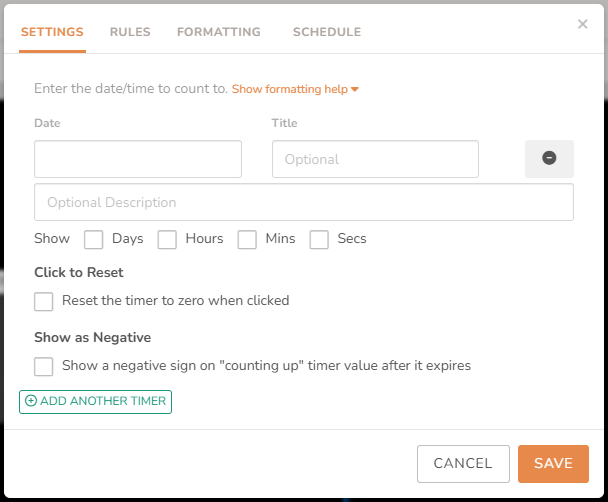
| Setting | What it does | Example |
|---|---|---|
| Date | The date and time to count down to or count up from. Required. | December 25, 2026 |
| Title | Optional. A name for the timer, shown above the numbers. | Christmas |
| Optional Description | Optional. Extra text shown in smaller type below the numbers. | Days until the big day! |
| Show | Which units to show: Days, Hours, Mins and Secs. All are unchecked when you add a timer. If you leave out a larger unit, its time is added to the next unit you show (for example, with Days unchecked, 2 days and 3 hours shows as 51 Hours). | Check Days only for a simple day count. |
| Click to Reset | When checked, clicking or tapping the timer on the Screen (touchscreen or USB mouse) asks Reset timer?. Click OK and the timer's Date is replaced with the current date and time, so it starts counting up from zero. The old date is not kept. | A "Days since the last incident" counter. |
| Show as Negative | Adds a minus sign in front of the numbers when the date has passed, which includes every count up timer and a countdown after it ends. It does not change the numbers themselves. | A countdown 2 hours after it ends shows a minus sign before 0 Days 2 Hours. |
| Add Another Timer | Adds another timer to the same Block. To remove a timer, click the minus button next to it. Rules on the Rules tab apply to every timer in the Block. | Birthdays for each member of the family in one Block. |
Timers in the same Block are shown in date order, earliest date first, not in the order you added them.
Rules Tab:
Rules are optional. Use them to change the timer when it gets close to, reaches, or passes its date: change its colors, stop it, hide it, or play an alert tone.
Rules apply to every timer in the same Block. If you need different effects for each timer, add another Countdown/Count Up Timer Block.
How Rules Work:
Each rule reads as If (a condition) Then (an action):
- The condition always starts with Timer Expired.
- Choose Is greater than or Is less than. New rules start with Is not equal selected, so always change it to the option you want. (For this Block, Is not equal works exactly like Is greater than, so we recommend choosing Is greater than.)
- Type a number of minutes. Use whole numbers only (60 = 1 hour, 1440 = 1 day). A blank box counts as 0. The number can be negative.
- Under Then, choose an action. Click And to add more actions to the same rule.
- Click Add rule to add another rule. If two rules apply at the same time and both set a color, the rule lower in the list wins.
Every rule is measured from the timer's date, which we call the expiration point. For a countdown, that is the moment it reaches zero. For a count up, it is the date it counts up from.
Timer Expired Is Greater Than:

Is greater than applies the actions for all of the time after the expiration point plus your number of minutes.
- Count up: with 15, the actions start 15 minutes after the date the timer counts up from.
- Countdown: with 15, the actions start 15 minutes after the countdown reaches zero. With 0, they start the moment it reaches zero.
- Before a countdown ends: use a negative number. With -15, the actions start 15 minutes before the countdown reaches zero and stay on afterwards.
Timer Expired Is Less Than:

Is less than applies the actions for all of the time before your number of minutes ahead of the expiration point.
- Countdown: with 15, the actions are on from now until 15 minutes before the countdown reaches zero, then they turn off. With 0, they stay on until the countdown reaches zero.
- Count up: with 0 or a positive number, this does nothing, because the date has already passed. With a negative number, such as -60, the actions are on for the first 60 minutes after the date.
Stop Counting cannot be used with Is less than, and Play alert tone only plays with Is greater than.
Rule Actions (Then and And):
These actions are available under Then, and again under each And:
| Action | What it does |
|---|---|
| Stop Counting | Freezes the numbers at the rule's value instead of letting the timer keep running. For example, Timer Expired Is greater than 0, Then Stop Counting freezes a countdown at zero when it ends. Use a value of 0 or more. Not available with Is less than. |
| Hide Counter | Hides the whole timer (title, numbers and description) and stops it counting. Colors set by other actions have no visible effect while it is hidden. |
| Set background color | Changes the background behind the timer, not the whole Block. Type a color name or hex code, for example red or #FF0000. |
| Set text color | Changes the color of the timer's text. Type a color name or hex code, for example white or #FFFFFF. |
| Play alert tone | Plays a sound once when the rule starts to apply. Choose Bell, Chime, Reception Bell, Ringtone or Wind Chimes, and click the play button to preview it. Use it with Is greater than. See Why Did the Alert Tone Not Play?. |
Rule Quick Reference:
| What you want | Rule to use |
|---|---|
| Countdown turns red in its last 15 minutes | Timer Expired Is greater than -15, Then Set background color red |
| Countdown stops at zero instead of counting up | Timer Expired Is greater than 0, Then Stop Counting |
| Countdown disappears 1 day after it ends | Timer Expired Is greater than 1440, Then Hide Counter |
| Chime when the countdown ends | Timer Expired Is greater than 0, Then Play alert tone, Chime |
| Countdown shows green text until the last hour | Timer Expired Is less than 60, Then Set text color green |
| Count up changes color after 30 minutes | Timer Expired Is greater than 30, Then Set text color orange |
Examples:
Count Down to a Birthday:
- Add the Countdown/Count Up Timer Block (see Add the Countdown/Count Up Timer Block).
- In Date, type the birthday, for example
June 12, 2027. - In Title, type Emma's Birthday.
- Under Show, check Days only.
- Save. The Block shows the number of days left. With Days only, part of a day is rounded up, so with 1 day and 5 hours left it shows 2 Days.
Optional: on the Rules tab, add Timer Expired Is greater than 0, Then Play alert tone, and choose a sound, so the Screen plays a tone when the birthday starts.
Count Up Since a Date:
- In Date, type a date in the past, for example
January 1, 2023. - In Title, type Days Since We Opened.
- Under Show, check Days.
- Save. The timer counts up from that date.
For a counter you reset by hand (for example, "Days since the last incident"), also check Click to Reset. Tapping the timer on the Screen and clicking OK sets its Date to the current date and time, so it starts again from zero.
Show a Message When the Timer Ends:
Rules cannot change the timer's text, but you can show a message when the timer ends by using two Countdown/Count Up Timer Blocks with the same date:
- Block 1, the countdown: Date
December 31, 2026 11:59 pm, Title New Year, check Hours, Mins and Secs. On the Rules tab, add Timer Expired Is greater than 0, Then Hide Counter. The countdown disappears when it reaches zero. - Block 2, the message: the same Date, Title Happy New Year!, and leave all the Show boxes unchecked so only the title shows. On the Rules tab, add Timer Expired Is less than 0, Then Hide Counter. The message stays hidden until the countdown reaches zero.
- Optional: in Block 2, add a second rule, Timer Expired Is greater than 1440, Then Hide Counter, to hide the message again 1 day later.
- Place Block 2 over or next to Block 1 on your Custom Screen.
Formatting Tab:
The Formatting tab sets how the Block looks.
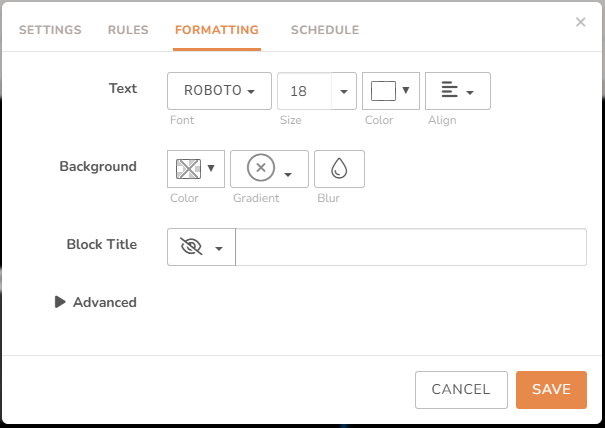
- Font and Text: choose the font, the font size and color, and align the text to the left, center, or right of the Block.
- Background: set the Block's background color, add a gradient, or blur the background.
- Block Title: a name for the Block. Use the eye icon to show it on the Block or hide it. A Block Title also helps you target the Block with Custom CSS.
The Advanced section of the Formatting tab has more options, such as Block size and position. To learn more, see Advanced Features of the Custom Screen Editor.
Schedule Tab:
The Schedule tab lets you show the Block only on the days and times you choose. See Content Scheduling to learn how to use it.
Frequently Asked Questions:
Below are the most frequently asked questions about the Countdown/Count Up Timer Block.
Why Does My Timer Show Thousands of Days?
Why this happens: The Date box is empty or the date could not be read (for example, a typo in the month name). When that happens, the timer counts up from January 1, 1970.
How to fix it:
- Open the Block and check the Date box.
- Retype the date using one of the formats in Enter the Date and Time, for example
June 12, 2027 5:00 pm. - Save the Block.
Why Is My Timer Off by a Few Hours?
Why this happens: The timer uses the time zone set in your Custom Screen's Screen Settings, not the time zone of the device showing it.
How to fix it: Set the correct time zone in your Screen Settings and save. See How to Set the Timezone.
Why Did My Tomorrow or Friday Timer Move to a New Date?
Why this happens: Words like tomorrow and friday are worked out from the moment the Screen loads. Each time the Screen reloads, they point to the next tomorrow or Friday. Displays reload your Screen automatically every 6 hours (from when a DAKOS device started up, or from when the Screen was opened on your own device), and each time you click Refresh Displays on a Paid Subscription.
How to fix it: To count to one fixed moment, type the full date and time, for example March 5, 2027 5:00 pm.
What Happens When a Countdown Reaches Zero?
It keeps going and counts up the time since the date. To change that:
- To freeze it at zero, add the rule Timer Expired Is greater than 0, Then Stop Counting.
- To hide it, add the rule Timer Expired Is greater than 0, Then Hide Counter.
- To show that the date has passed, check Show as Negative to add a minus sign.
Why Did the Alert Tone Not Play?
Why this happens: The alert tone plays once, within a few seconds of the moment the rule starts to apply, and only while the Block is visible. It does not play if the Screen loads after that moment, if the Block is hidden by its schedule, or if the rule uses Is less than. It also will not play if the device's volume is turned off or its browser blocks the page from playing sound.
How to fix it:
- Use Is greater than in the rule (for example, Timer Expired Is greater than 0 for the moment a countdown ends).
- Make sure the Screen is open, and the Block visible, at that moment.
- Check that the device's sound is on and its volume is up.
Why Did My Timer Date Change After I Clicked the Timer?
Why this happens: Click to Reset is checked for that timer. When someone clicks or taps the timer and clicks OK, its Date is replaced with the current date and time.
How to fix it: Open the Block, type the date you want back in the Date box, and save. To stop this happening, uncheck Click to Reset.
Why Does the Days Count Show One More Day Than I Expected?
Why this happens: When only Days is checked on a countdown, any part of a day is counted as a full day, so with 1 day and 5 hours left it shows 2 Days.
How to fix it: To see the exact time left, also check Hours (and Mins if you like).
Can Each Timer in the Block Have Its Own Rules?
No. Rules apply to every timer in the same Block. To give a timer its own rules, put it in its own Countdown/Count Up Timer Block.
Why Are My Timers in a Different Order Than I Entered Them?
Timers in the same Block are always sorted by date, earliest date first. To show timers in a set order, put them in separate Blocks.
Helpful Articles:
Having trouble? See if these articles help.
How to Use the Custom Screen Live Editor